
Between your samples
A sample describes one moment. The Mosselmonitor measures the valve position of every mussel in each measuring cycle and operates stand-alone, day and night.
The Mosselmonitor® follows the valve movement of eight live mussels and signals when their behaviour changes. That gives you a continuous biological early warning between your routine samples, as a complement to chemical analysis. Available as an In-Situ and as a Flow-Through version.
Chemical monitoring measures the compounds you select. A biological early-warning system watches how living organisms respond to the water as a whole.
A sample describes one moment. The Mosselmonitor measures the valve position of every mussel in each measuring cycle and operates stand-alone, day and night.
Mussels filter the water continuously and respond to a wide range of substances, including ones that are not on your analysis list. They show that something has changed, not which substance it is.
When the set criteria are met, a potential-free contact closes. You can use it to notify staff, to start an automatic sampler for chemical confirmation, or to trigger your own procedure.
The quality of raw water can change between two samples. A Mosselmonitor at the intake watches the water continuously and closes an alarm contact when several mussels change their behaviour at the same time. Your operators or your control system decide what follows: an extra sample, a check, or a temporary stop of the intake.
The Mosselmonitor records the valve movement of eight bivalves continuously. Each animal is measured and evaluated separately, so you can study individual responses as well as the group.
Both versions use the same measuring principle and the same alarm functions. The difference is where the mussels are: in the water body itself, or in a tank that the water flows through.
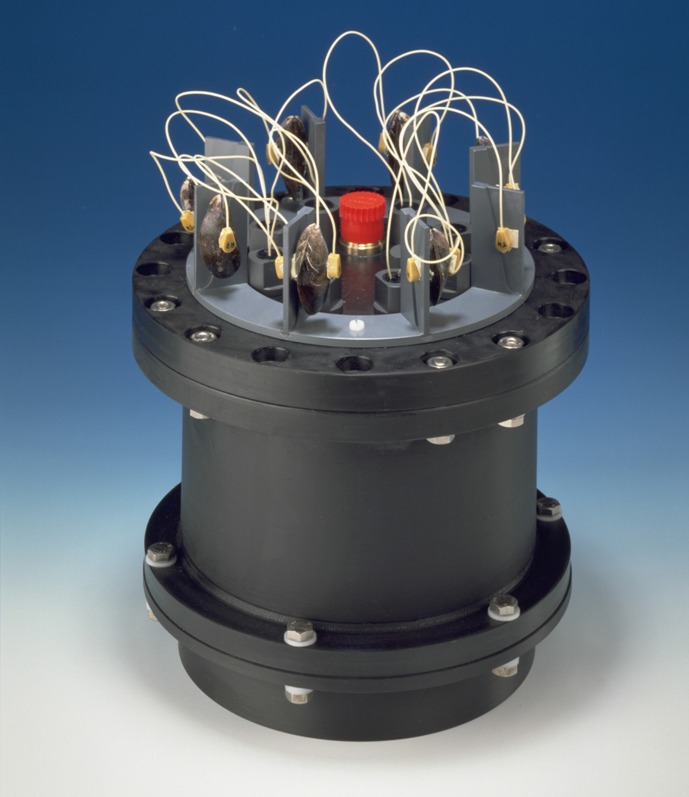
A submersible unit in an HD-polyethylene housing with a protective cover, for direct deployment in the water body at depths down to 15 metres. A communication cable connects the unit to a cable reel with a junction box, for power, alarm contact and PC.
Typical use: rivers, lakes, harbours and intake points without a building.
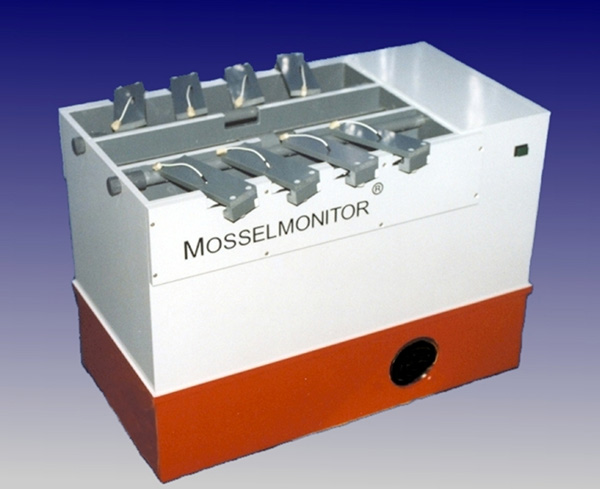
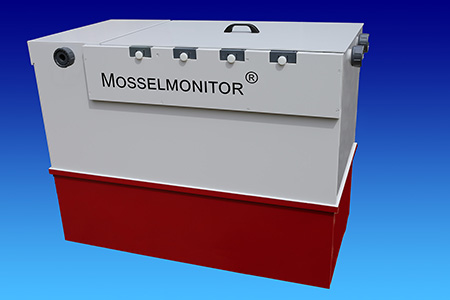
A PVC tank with light-excluding lids and removable mussel holders, for installation in pumping stations, monitoring stations and laboratories. The water is led through the tank at 150 to 200 litres per hour.
Typical use: intake stations, effluent monitoring and laboratory studies.
| In-Situ | Flow-Through | |
|---|---|---|
| Location | In the water body itself | Pumping station, monitoring station or laboratory |
| Water | Surrounding water, down to 15 m depth | Supplied through the tank, 150 to 200 L/h |
| Housing | HD-polyethylene with protective cover | PVC tank with lids, volume 35 litres |
| Dimensions | Ø 320 mm, height 420 mm; 17 kg plus 5 kg ballast | 760 x 420 x 350 mm (L x W x H) |
| Connection | Cable reel with junction box, 15 m cable as standard | Inlet Ø 20 mm, outlet Ø 40 mm; electrical connections on the unit |
Measuring principle, alarm functions and the electrical and mechanical data of both versions.
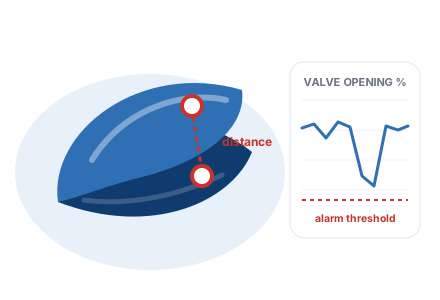
Download the datasheet (pdf)Healthy mussels are open most of the time to breathe and feed. When the water changes, their behaviour changes: they stay closed longer, open and close more often, or open less and less.
Each shell half carries a small coil. The signal between the two coils is a direct measure of the valve opening, read out for every mussel separately.
The built-in microprocessor compares each mussel with its own earlier behaviour and tests the result against the criteria you set. If they are met, the alarm contact closes.
In use at, among others







A few lines are enough. We reply personally and, where it helps, with a proposal for the version and set-up that fit your situation.
Prefer to call or e-mail?